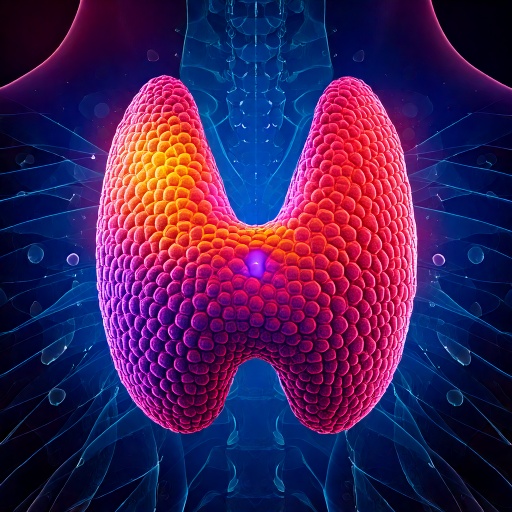
The amazing advances in artificial intelligence (AI) in medicine are already making themselves felt – and the diagnosis and treatment of thyroid disease is one of the areas where it could bring real breakthroughs. AI can not only increase diagnostic accuracy, but also reduce unnecessary interventions while providing faster and more efficient patient care.
AI in thyroid diagnostics: why is this a huge step forward?
One of the biggest challenges in the diagnosis of thyroid nodules is inaccuracy and subjectivity. Currently, diagnosis is mainly based on ultrasound imaging and biopsy, but in many cases, the decision of the specialist is intuitive and based on experience. The majority of biopsies ultimately confirm a benign lesion, which indicates that a lot of unnecessary interventions are performed, causing stress and unnecessary risk to patients.
This is where artificial intelligence comes in, taking the evaluation of thyroid nodules to a whole new level. AI-based algorithms use deep learning models to analyse ultrasound images and provide an objective, accurate diagnosis. Research so far shows that these models can detect subtle details that the human eye might not necessarily notice, increasing the reliability of the diagnosis.
How does AI work in thyroid diagnostics?
Dr. Johnson Thomas, a researcher at Mercy Hospital and Missouri State University, is working to develop AI-based models that reduce diagnostic uncertainty and increase the accuracy of cancer lesion detection.
🔹 Developing risk stratification – AI is creating systems that predict the likelihood of malignant lesions based on the characteristics of the nodules (e.g. hypoechoicity, irregular edges). This helps doctors make more accurate decisions and avoid unnecessary biopsies.
🔹 Automated ultrasound analysis – Instead of having a technician manually evaluate ultrasound images, AI algorithms with convolutional neural networks (CNNs) autonomously analyze images and provide reliable predictions. This not only makes diagnosis faster and more accurate, but also minimises the possibility of human error.
🔹 Decision support – Experts often use empirical evidence to decide whether a thyroid nodule is benign or malignant. However, AI provides scientifically sound predictions that doctors can use to confirm their decisions, reducing subjectivity and the risks associated with differing opinions.
Why is this a paradigm shift in healthcare?
The use of artificial intelligence in the diagnosis of thyroid diseases is not just a technological innovation, but a complete change of approach in medicine. More accurate diagnosis means fewer unnecessary interventions, which reduces the burden on patients, the cost to healthcare systems and increases the effectiveness of treatments.
🔹 Fewer unnecessary biopsies = less stress and faster care.
🔹 More accurate diagnosis = early detection of malignant lesions, better treatment outcomes.
🔹 Automated and objective analysis = increased reliability of medical decision-making.
What does the future hold?
Artificial intelligence is only taking the first steps in thyroid medicine, but it is already showing signs of revolutionising diagnostic and treatment processes. By using AI, doctors can make more precise, faster and more informed decisions, which in the long term could lead to a dramatic improvement in the quality of patient care.
For Semmelweis University students, this is an exciting time to be witnessing a technological breakthrough that could put thyroid diagnostics and precision medicine on a whole new footing. AI is not just the future, it’s the present – and the next big step in healthcare innovation is happening right now.