
Why Do We Get Goosebumps? The Science Behind This Strange Body Reaction
Author:Setayesh Ghanbarzadeh
Have you ever listened to a powerful song, watched an emotional movie scene, or stepped outside into cold weather and suddenly noticed tiny bumps appearing on your skin? These are called goosebumps. Although almost everyone experiences them, few people know what actually causes this unusual reaction.
Goosebumps are more than just a response to cold. They reveal an interesting connection between our skin, nervous system, and emotions.
What Exactly Are Goosebumps?
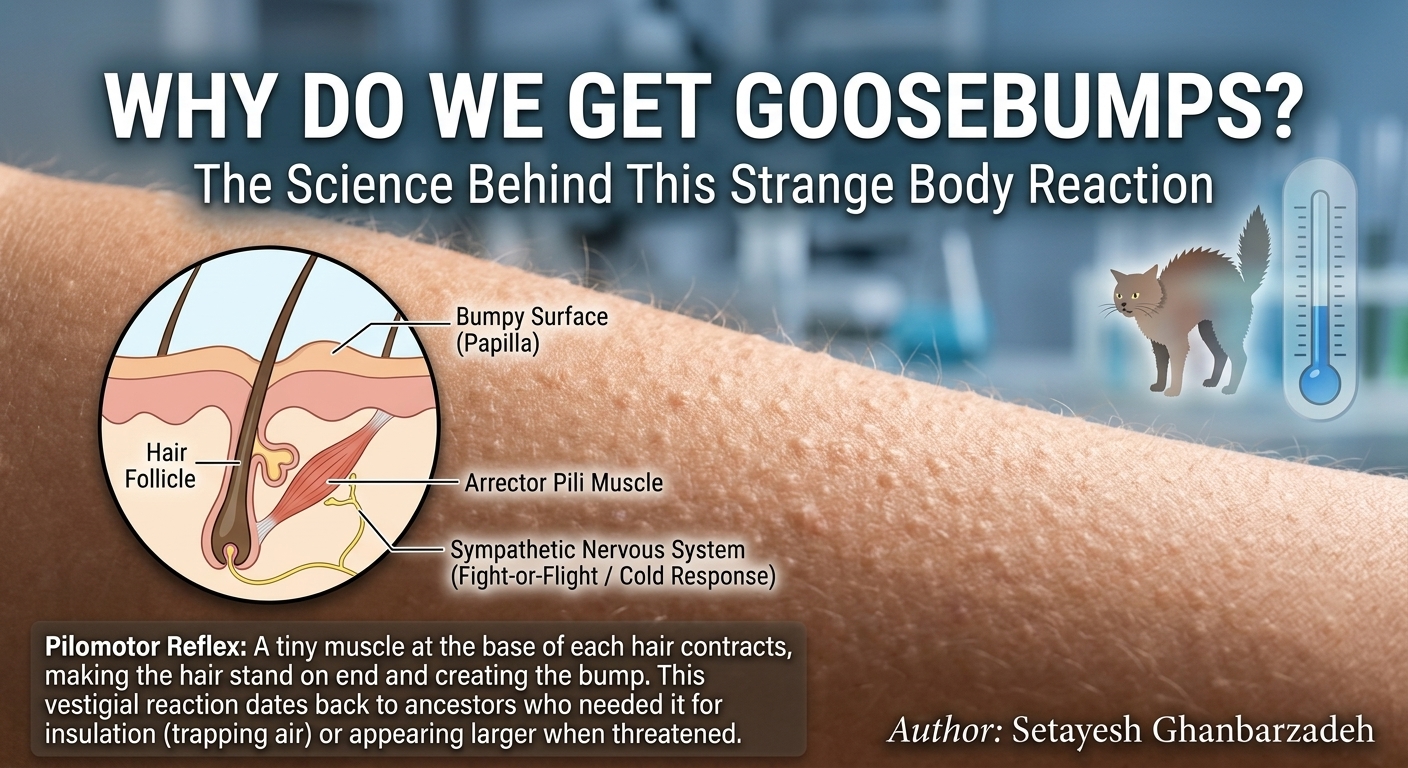
The scientific name for goosebumps is piloerection. This reaction happens when tiny muscles attached to hair follicles contract, making individual hairs stand upright and creating small bumps on the skin.
The process is controlled by the sympathetic nervous system, a part of the autonomic nervous system that helps prepare the body to respond to changes and potential challenges.
In simple terms, goosebumps are an automatic reaction. You cannot consciously decide to produce them or stop them immediately.
Why Do We Get Goosebumps When We Are Cold?
Goosebumps have an evolutionary explanation.
Our distant ancestors had much thicker body hair than modern humans. When their bodies became cold, the muscles around their hair follicles contracted, making the hairs stand upright. This helped trap a layer of warm air close to the skin.
A similar mechanism can be observed in animals today. For example, a cat may raise its fur when it feels threatened or cold.
Humans have much less body hair, so this reaction no longer provides significant warmth. Nevertheless, the biological mechanism remains part of our body’s response system.
Why Can Music Give Us Goosebumps?
One of the most fascinating things about goosebumps is that they can happen even when we are perfectly warm.
A beautiful piece of music, an emotional film scene, a surprising moment, or an inspiring speech can sometimes cause a sudden chill.
Researchers call this experience emotional piloerection or aesthetic chills. It is associated with strong emotional responses and activity in the sympathetic nervous system.
A systematic review published in 2022 examined research on emotional goosebumps. It found that these experiences were often accompanied by changes in physiological responses, including skin conductance and heart rate. However, scientists still do not fully understand why certain emotional experiences trigger this reaction in some people but not others.
What Happens Inside Your Body?
When something triggers goosebumps, a chain of events takes place:
- Your body detects a stimulus, such as cold, fear, excitement, or emotionally powerful music.
- The nervous system responds automatically.
- Sympathetic nerve activity activates tiny muscles attached to hair follicles.
- These muscles contract, causing the hairs to stand upright.
- Small bumps become visible on the skin.
This entire process happens without conscious effort.
Five Interesting Facts About Goosebumps
- They are not always caused by cold: Strong emotions can trigger them even in a warm environment.
- Animals use them differently: Raised fur can make an animal appear larger when it feels threatened.
- Music can trigger physical reactions: Emotional chills may be accompanied by measurable changes in the body.
- The reaction is involuntary: It is controlled by the autonomic nervous system.
- Scientists are still studying them: Emotional goosebumps offer an interesting way to explore the relationship between physical sensations and emotions.
Final Thoughts
Goosebumps may seem like a small and ordinary reaction, but they tell a fascinating story about human evolution and the nervous system.
The next time a song gives you chills or a cold breeze makes your skin bumpy, remember that your body is performing an automatic response that has been part of our evolutionary history for a very long time.
Sometimes, even the smallest reactions can reveal something extraordinary about how the human body works.
Author: Setayesh Ghanbarzadeh
Scientific References
- Cleveland Clinic. (2025). Why You Have Goosebumps on Your Skin.
- NIH Research Matters. (2020). What Goosebumps Are For.
- The Physiological Study of Emotional Piloerection: A Systematic Review and Guide for Future Research. (2022). International Journal of Psychophysiology.
https://doi.org/10.1016/j.ijpsycho.2022.06.010
- Benedek, M., & Kaernbach, C. (2011). Physiological Correlates and Emotional Specificity of Human Piloerection. Biological Psychology.