
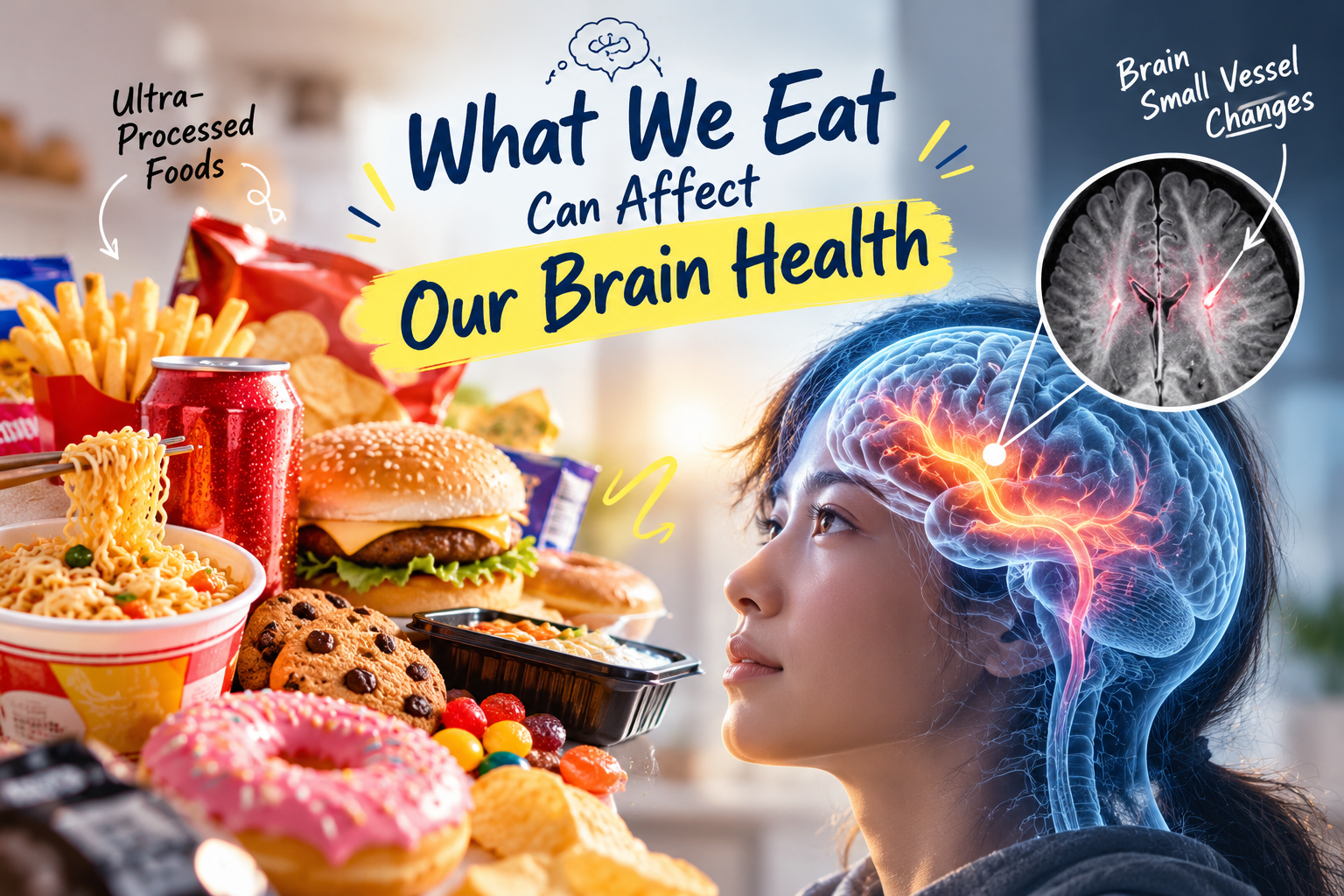
Instant noodles, packaged snacks, sugary cereals, soft drinks, and ready-made meals are convenient, especially when life gets busy. But could eating too many ultra-processed foods be linked to changes in the brain — even before we notice any symptoms?
A recent study examined 8,783 Canadian adults aged 35–69 who did not have cardiovascular disease. Researchers compared participants’ diets with MRI scans and cognitive test results.
The findings were interesting. People in the group with the highest ultra-processed food intake had about 40% higher odds of signs of small-vessel brain injury than those in the group with the lowest intake. These changes can be detected on MRI even when a person does not notice obvious problems with memory or thinking.
However, the study did not find significant differences in participants’ performance on the cognitive tests. The researchers also emphasized an important limitation: because diet and brain scans were assessed in a cross-sectional analysis, the study cannot prove that ultra-processed foods caused the brain changes.
So, does this mean you must never eat instant noodles or packaged snacks again? Not necessarily. The goal is not to label individual foods as completely “good” or “bad,” but to think about your overall eating pattern.
A practical approach is to eat more minimally processed foods, such as vegetables, fruit, beans, whole grains, and nuts, while making highly processed snacks and meals a smaller part of your usual diet when possible.
The takeaway: Brain health is about more than memory exercises and puzzles. What we eat may matter too — but scientists need more long-term research to understand exactly how diet affects the brain.
Source: Medscape Medical News
https://www.medscape.com/viewarticle/ultraprocessed-foods-linked-silent-brain-injury-2026a10013en?_gl=1*1gi0l62*_gcl_au*NDk4MTgwNDc2LjE3ODk3MTkwOTIuMTAwMjc5OTYxOC4xNzkxODE5NTU3LjE3OTE4MTk1NTYuMTgwNjY3OTE3OC4xNzkxODE5NTU3LjE3OTE4MTk1NTY.