
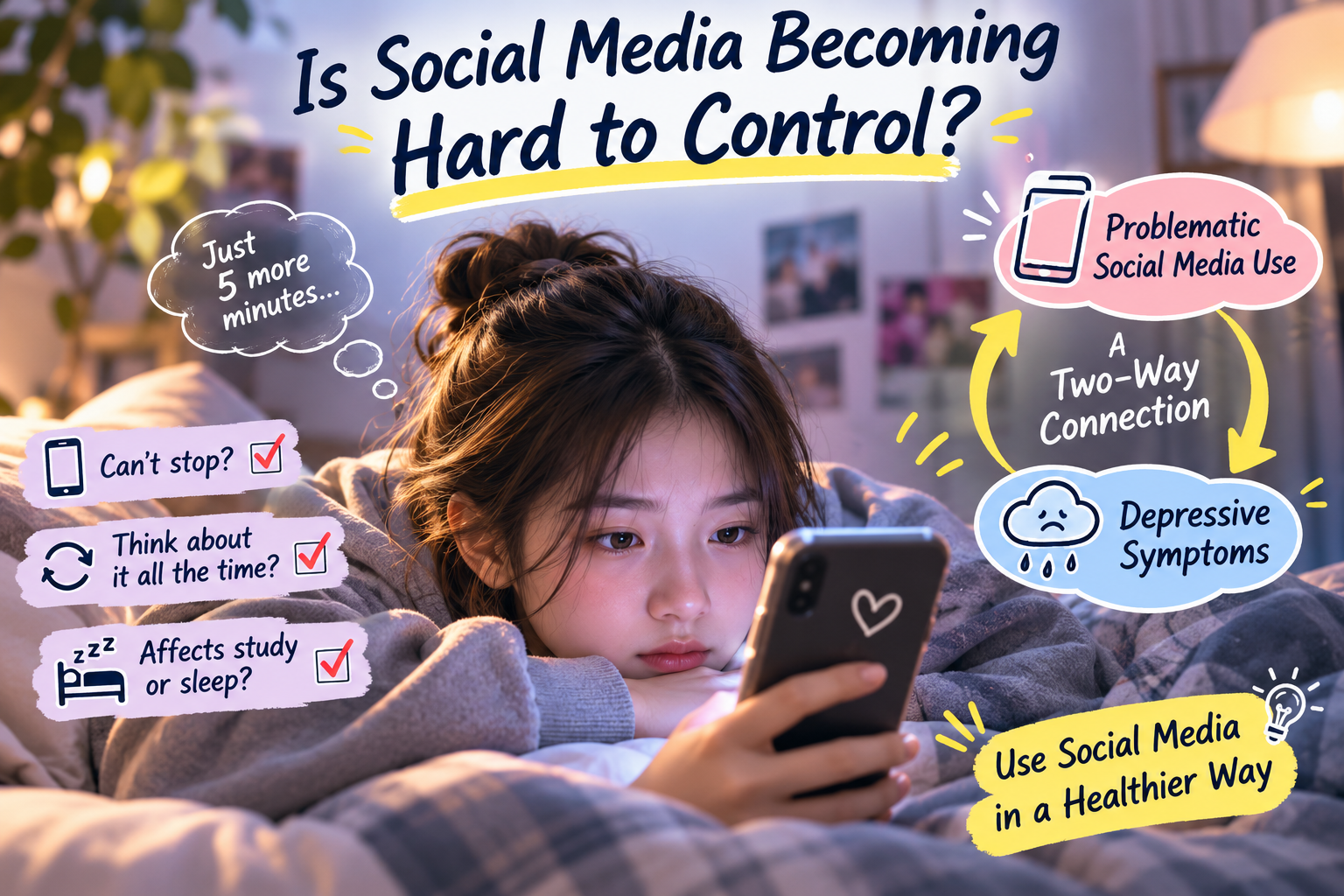
Checking notifications, scrolling through videos, and replying to messages are part of everyday life for many young people. But when does normal social media use become a problem?
A recent study followed 11,279 adolescents in the United States over five years to explore the relationship between problematic social media use and mental health. Researchers looked at behaviors such as feeling unable to stop using social media, constantly thinking about it, and experiencing conflict because of it.
The findings revealed an interesting two-way relationship. During certain periods of the study, adolescents who showed more problematic social media use later reported more depressive symptoms. At the same time, those who experienced more depressive symptoms were also more likely to develop problematic patterns of social media use later.
Interestingly, the researchers did not find the same significant long-term relationship between problematic social media use and anxiety symptoms. The associations with depressive symptoms were also stronger and more consistently bidirectional among girls than boys.
However, this does not mean that social media automatically causes depression. The relationship was not consistent at every assessment, and the study cannot prove that one factor directly causes the other.
So, what can we learn from this? Instead of focusing only on how many hours we spend online, it may be more useful to notice how social media affects our daily lives. Can you put your phone away when you need to study or sleep? Do you feel uncomfortable when you cannot check your accounts?
The takeaway: Social media is a tool for connection and entertainment, but it should not control your day. Building a healthier relationship with technology starts with noticing your habits.
Source: Medscape Medical News
https://www.medscape.com/viewarticle/problematic-social-media-use-tied-depressive-symptoms-2026a10016ii?src=rss&utm_source=chatgpt.com