Think your body feels strange after a long flight? Try leaving the planet.
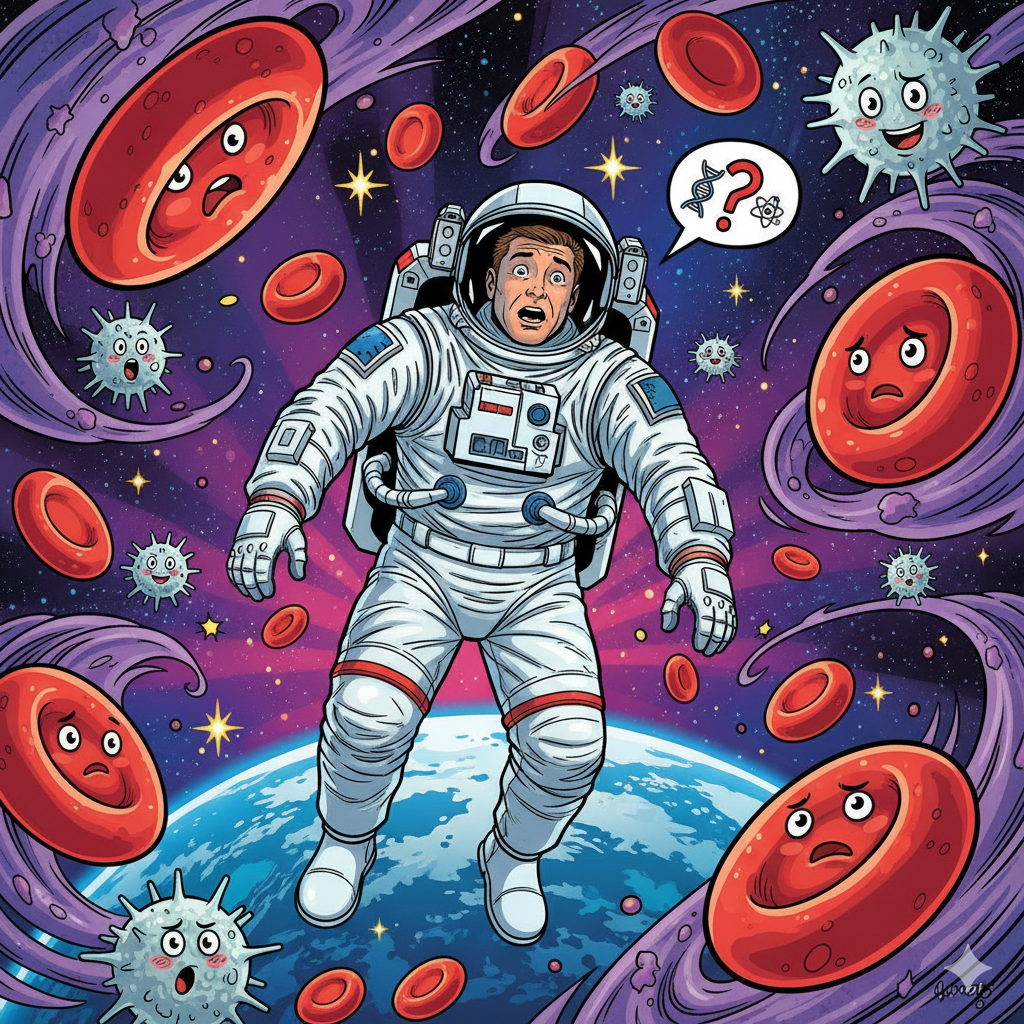
Scientists studying astronauts have discovered that even your blood gets weird in space — and it’s not just floating around in little red blobs for cool videos. In zero gravity, the way your red and white blood cells move, function, and even talk to each other changes in ways no one expected.
Without gravity’s constant pull, blood doesn’t know where to go. It rushes toward the head, slows down in other areas, and messes with pressure throughout the body. Astronauts often describe feeling “puffy-faced” and “heavy-headed,” not because they’re tired — but because their circulation is literally upside down.
And here’s where it gets wild: scientists have found that in space, red blood cells die off faster and the body doesn’t replace them as efficiently. Some immune cells become overactive, while others take an extended nap. It’s like your blood can’t decide whether to panic or chill out. As one researcher put it, “space doesn’t just change your body — it confuses it.”
But this “space blood” story isn’t just about astronauts turning into floating science experiments. It’s helping scientists understand how microgravity reshapes human biology — from how oxygen moves through our veins to how inflammation works. What’s learned up there could help us treat diseases like anemia, immune dysfunction, and even certain inflammatory disorders back here on Earth.
And there’s a poetic side to it all. The same human blood that once pulsed only under Earth’s skies is now adapting to an entirely new world — teaching us how resilient life can be.
So next time you look up at the stars, remember: someone up there isn’t just exploring space — they’re rewriting the rules of human biology, one heartbeat at a time.